

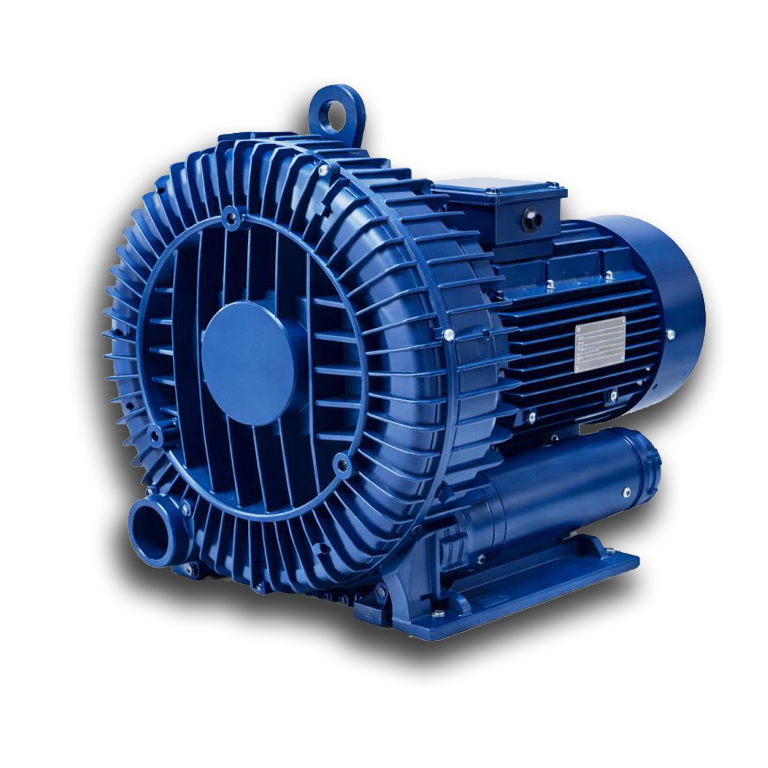
Pressure vs Vacuum Performance Optimisation in Ring Blowers
Ring blowers are unique industrial air systems because they can operate in both pressure (blowing) and vacuum (suction) modes using the same machine. This dual capability makes them extremely versatile for modern industries. However, to get the best results, it is important to optimise performance differently for pressure and vacuum applications.
Understanding how to balance and optimise pressure and vacuum performance in ring blowers helps industries achieve:
- Higher efficiency
- Lower energy consumption
- Better process stability
- Longer equipment life
- Reduced maintenance
- Improved productivity
This blog explains the difference, behaviour, and optimisation of pressure and vacuum performance in ring blower systems in a simple and practical way.
Understanding Pressure and Vacuum in Ring Blowers
🔵 Pressure Mode (Blowing)
In pressure mode, the ring blower:
- Pushes air out
- Creates positive pressure
- Delivers airflow to the process
- Supports blowing and conveying applications
Examples: pneumatic conveying, drying, cooling, aeration, filtration, air knives.
🟢 Vacuum Mode (Suction)
In vacuum mode, the ring blower:
- Pulls air in
- Creates negative pressure
- Generates suction force
- Supports vacuum-based processes
Examples: vacuum lifting, packaging, dust extraction, sheet handling, vacuum conveying.
How Ring Blowers Generate Both
Ring blowers use regenerative airflow technology:
- Air is accelerated repeatedly
- Energy is added in cycles
- Pressure builds gradually
- Flow remains stable
The same airflow system creates:
- Positive pressure at the outlet
- Negative pressure at the inlet
This allows dual-function operation.
Performance Characteristics
Pressure Performance Characteristics
Optimised pressure systems focus on:
- Stable airflow delivery
- Controlled pressure output
- Continuous flow
- Low pulsation
- Energy efficiency
Pressure systems work best when:
- Flow resistance is controlled
- Pipe design is optimised
- Load is stable
- Flow is not blocked
Vacuum Performance Characteristics
Optimised vacuum systems focus on:
- Strong suction force
- Stable vacuum level
- Leak-free systems
- Low air loss
- Efficient sealing
Vacuum systems perform best when:
- Leakage is minimised
- Sealing is strong
- Pipe lengths are optimized
- Flow losses are reduced
Pressure vs Vacuum Optimisation Strategies
🔵 Optimising Pressure Performance
1. Correct Blower Sizing
Avoid over-sizing or under-sizing.
2. Airflow Matching
Match blower flow to process demand.
3. Pipe Design Optimisation
- Larger diameter pipes
- Fewer bends
- Smooth internal surfaces
4. Flow Resistance Control
Minimise filters, sharp turns, and restrictions.
5. Pressure Regulation
Use pressure control valves and sensors.
6. Energy Optimisation
Use VFD drives for speed control.
7. Temperature Management
Avoid overheating due to excessive load.
🟢 Optimising Vacuum Performance
1. Leak Prevention
Seal all joints and connections.
2. Suction Line Design
Short, straight suction lines perform best.
3. Proper Filtration
Protect blower without airflow restriction.
4. Vacuum Level Control
Use vacuum regulators and sensors.
5. Load Management
Avoid overloading suction systems.
6. System Tightness
Ensure airtight pipelines.
7. Stage Selection
Use double-stage blowers for higher vacuum.
Single-Stage vs Double-Stage Performance
Single-Stage Ring Blowers:
- High airflow
- Moderate pressure/vacuum
- Energy efficient
- Best for continuous light-duty systems
Double-Stage Ring Blowers:
- Higher pressure
- Higher vacuum
- Stronger force
- Suitable for heavy-duty applications
Choosing the right stage is critical for performance optimisation.
System Design Impact on Performance
Performance is not just about the blower — it is about the entire system:
- Pipe length
- Pipe diameter
- Valves and fittings
- Filters
- Environmental temperature
- Installation layout
- Process demand
- Load variations
Bad system design = poor performance, even with a good blower.
Energy Efficiency and Optimisation
Optimised pressure and vacuum systems deliver:
- Lower power consumption
- Reduced heat generation
- Less mechanical stress
- Higher efficiency
- Longer motor life
- Lower operating costs
Automation and Smart Optimisation
Modern ring blower systems use:
- Smart sensors
- VFD controllers
- PLC systems
- IoT monitoring
- Predictive maintenance
- Digital dashboards
This allows real-time performance optimisation for both pressure and vacuum modes.
Industrial Applications
Pressure Mode Applications:
- Pneumatic conveying
- Air drying
- Cooling systems
- Aeration
- Filtration systems
- Industrial drying
- Air knives
Vacuum Mode Applications:
- Vacuum lifting
- Packaging
- Dust extraction
- Sheet handling
- Central vacuum systems
- Vacuum conveyors
- Material handling
Common Performance Problems
Pressure Issues:
- Low pressure output
- Excessive energy usage
- Overheating
- Noise increase
- Flow instability
Vacuum Issues:
- Weak suction
- Leakage losses
- System inefficiency
- Poor sealing
- Pressure drops
These are usually system design problems, not machine problems.
Business Benefits of Optimisation
Industries that optimise pressure and vacuum performance achieve:
📈 Higher productivity
📉 Lower energy bills
🛠 Reduced maintenance
🔁 Reliable operations
⚙ Stable processes
🌱 Sustainable production
🏭 Long equipment life
📊 Process efficiency
🔒 Operational safety
Future of Performance Optimisation
With Industry 4.0, optimisation becomes intelligent:
- AI-driven airflow control
- Predictive maintenance
- Smart automation
- Digital twins
- Data-based optimisation
- Autonomous systems
Air systems will self-optimise.
Conclusion
Pressure vs vacuum performance optimisation in ring blowers is not about choosing one over the other — it is about designing systems that extract the best performance from both modes.
Ring blowers are unique because they provide:
- Dual-function capability
- Stable airflow
- Continuous operation
- Energy efficiency
- Clean air systems
- Reliable performance
By optimising both pressure and vacuum performance, industries build:
- Efficient factories
- Smart systems
- Sustainable operations
- Reliable production lines
- Cost-effective processes
In modern industry, air is not just air —
Air is power, performance, and productivity.

Leave A Comment