

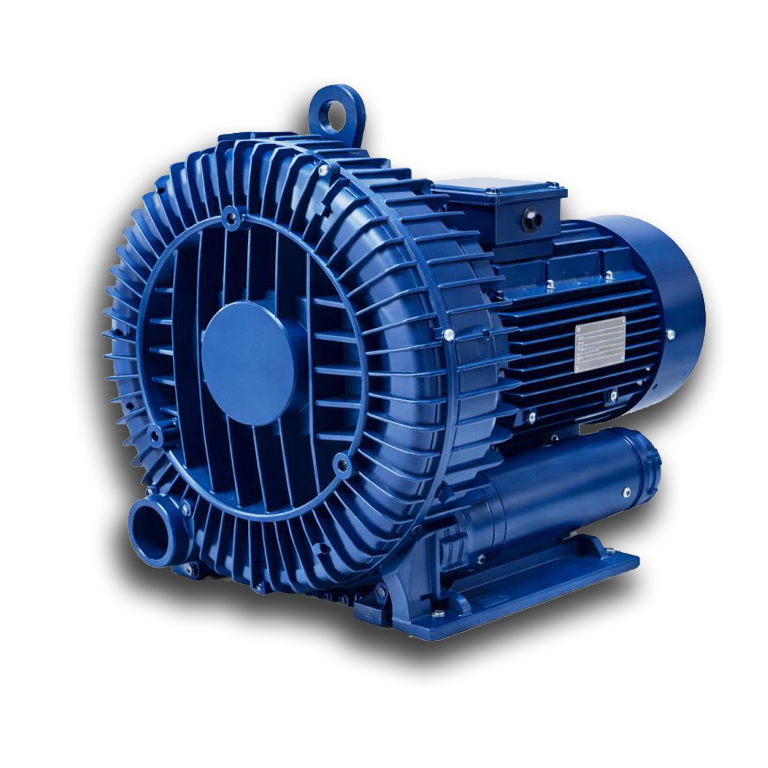
Single-Stage vs Double-Stage Ring Blowers: What’s the Difference?
When choosing a ring blower, one of the most common questions is whether to select a single-stage or a double-stage ring blower. Both work on the same basic principle, but they are designed for different pressure and application needs.
What Is a Single-Stage Ring Blower?
A single-stage ring blower moves air through one side channel (ring). The air circulates once around the impeller and exits the blower with increased pressure or vacuum.
Key Features of Single-Stage Ring Blowers
- One ring / one stage of airflow
- Moderate pressure and vacuum
- Lower power consumption
- Compact and lightweight design
- Cost-effective solution
Best Applications for Single-Stage Ring Blowers
- Wastewater aeration (small systems)
- Packaging and bottling
- Printing and paper handling
- Medical and laboratory equipment
- Light pneumatic conveying
Single-stage ring blowers are ideal when high pressure is not required.
What Is a Double-Stage Ring Blower?
A double-stage ring blower moves air through two side channels (two rings). After the first stage, air passes into the second stage, where pressure or vacuum increases further.
Key Features of Double-Stage Ring Blowers
- Two rings / two stages of airflow
- Higher pressure and vacuum capability
- Suitable for demanding applications
- Strong and robust design
- Continuous industrial operation
Best Applications for Double-Stage Ring Blowers
- Central vacuum systems
- Pneumatic conveying over long distances
- Industrial drying systems
- Heavy-duty aeration
- Applications requiring higher pressure
Double-stage ring blowers are used when more power and pressure are needed.
Working Principle Comparison (Simple)
Single-Stage Working
- Air enters the blower
- Circulates once in the ring
- Gains energy
- Exits as pressure or vacuum
Double-Stage Working
- Air enters the first ring
- Gains pressure
- Moves to the second ring
- Gains additional pressure
- Exits with higher output
Single-Stage vs Double-Stage Ring Blowers: Comparison Table
| Feature | Single-Stage Ring Blower | Double-Stage Ring Blower |
| Number of Stages | One | Two |
| Pressure Level | Low to medium | Medium to high |
| Vacuum Capability | Moderate | High |
| Power Consumption | Lower | Higher |
| Size | Smaller | Slightly larger |
| Cost | Lower | Higher |
| Maintenance | Very low | Very low |
| Noise Level | Low | Slightly higher |
Energy Efficiency Comparison
- Single-stage ring blowers are more energy-efficient for low-pressure applications.
- Double-stage ring blowers consume more power but deliver higher pressure and vacuum.
Choosing the right stage helps avoid wasting energy and money.
Noise and Maintenance
Both single-stage and double-stage ring blowers:
- Are oil-free
- Require very little maintenance
- Have low vibration
Double-stage blowers may produce slightly more noise due to higher pressure, but they are still quieter than many other industrial blowers.
Which One Should You Choose?
Choose a Single-Stage Ring Blower if:
- Your application needs low to medium pressure
- You want lower power consumption
- Space is limited
- Budget is important
Choose a Double-Stage Ring Blower if:
- Your application needs higher pressure or vacuum
- Air must travel longer distances
- You need stronger performance
- Industrial demand is high
Common Mistake to Avoid
A common mistake is choosing a double-stage blower when a single-stage is enough. This increases cost and power usage unnecessarily.
Always select the blower based on:
- Required pressure
- Airflow volume
- Application type
- Operating hours
Conclusion
Both single-stage and double-stage ring blowers are reliable, oil-free, and low-maintenance air solutions. The main difference lies in pressure capability and power output.
Single-stage ring blowers are perfect for simple and energy-efficient applications, while double-stage ring blowers are designed for more demanding industrial needs.
Choosing the right stage ensures better performance, lower operating costs, and longer blower life.

Leave A Comment